Short answer: yes — a damaged section of your Houston garage door is usually replaceable on its own, and it almost always costs far less than a brand-new door. But whether that is possible for your specific door has little to do with how the dent looks. What settles it is availability: your door’s exact model, gauge, and stamp pattern must still be in production. If it is, we swap the section and you keep your door. If it is not, no shop can invent one, and the honest answer may be a new door. The damage is what you see; the label on the door is what settles the question.
This page is the Houston-specific version of that repair. It is not a generic “replace your panel” explainer — it covers how this metro’s mix of old inner-loop stock and new construction, its hurricane-season wind, and its Gulf humidity change what gets damaged, how the repair is priced, and where the line between a section and a whole door actually falls here.
A sectional door is built to be repaired in pieces
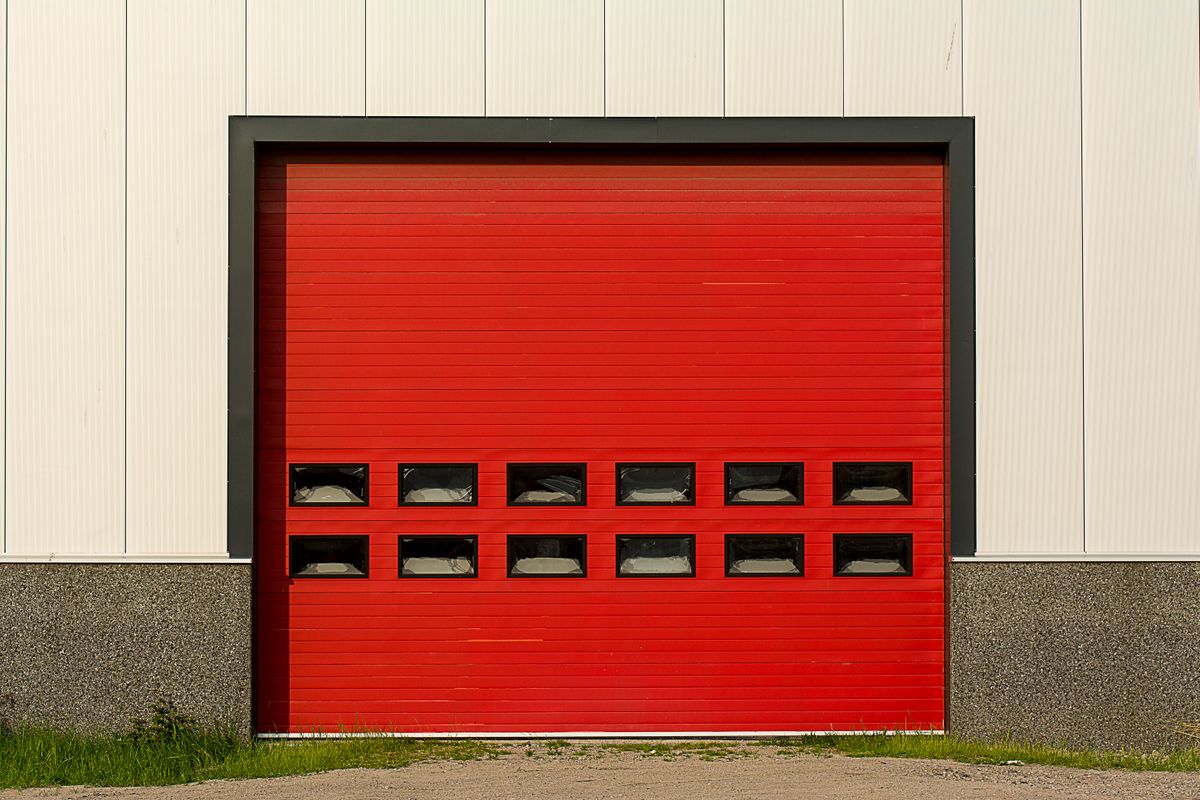
If you have never thought about it, a garage door looks like one solid sheet of metal filling the opening. It is not. The door you see is four or five horizontal slabs — called sections or panels interchangeably — hinged together so the whole thing can bend around the top-of-track curve and ride flat against the ceiling when it opens. Because those sections are separate pieces bolted to a shared hinge system, one damaged section can be removed and replaced without touching the others. That is the entire basis of this repair.
One piece of vocabulary trips people up. The word “panel” also refers to the decorative raised rectangles stamped into each section — the ones that make a flat steel door look like a classic carriage door. A single section can carry four of those rectangles, which is why a call about “my panel is dented” becomes a question about which section it is. Count from the bottom: section one is the bottom, and the windows usually sit in section three or four.
Two structural details matter more than most homeowners expect. Struts are the reinforcing bars bolted across the inside of a section; they are what stop a wide two-car door from sagging in the middle. Stiles are the vertical reinforcement at the section’s sides and centre where hinges and rollers bolt on. An impact that leaves the face of a section looking fine can still bend the stile behind a hinge, and that hidden bend — not the dent you can see — is what makes a door drag, catch, or run crooked afterwards. That is the real reason a “just cosmetic” dent sometimes still needs the section replaced.
What damages panels in Houston, neighbourhood by neighbourhood
The causes here are not exotic, but the metro’s geography and climate put some of them on a timer.
Backing accidents. This is still the most common way a section dies, in Houston as everywhere. A slow reverse into a door that is halfway up, or a door that starts closing onto an open tailgate, folds one or two bottom sections while leaving springs, cables, and opener untouched. Because the impact is low-speed, it is usually the ideal case for section replacement — the door keeps everything else, and the new section drops in. The one thing to check afterwards is whether the strike happened while the door was moving, because that can knock the rollers sideways in the track; see our off-track repair page for the overlap.
Hurricane-season wind and debris. The dramatic picture — a whole door peeled inward during a storm — does happen, but the far more common damage is quieter: the door flexes hard under wind load, and the centre of a section bows permanently. Afterwards you have a shallow curve, a seam that no longer seats flush, or a strut whose screws have pulled. A door that has been flexed once has lost some of its margin for the next storm, and if it carries a wind-load rating the bent section may compromise that rating even when it still operates.
Gulf humidity and the slab. Bottom sections fail in this region at a rate you will not see in dry climates. The bottom edge of the door sits against a concrete slab that stays damp through our long wet season, and steel rusts upward from that edge; wood and composite sections swell and delaminate. A section that looks acceptable from the street can be soft and rust-streaked from the inside, and that is the version that fails silently over years. Keeping sprinkler spray off the door is a genuinely free way to slow it down.
Heat-soak in older stock. An unconditioned Houston garage turns the door into the hottest surface in the house in summer. Insulated sections — a foam core between two thin steel skins — can delaminate over enough summers, the skin separating from the core and reading as a section that ripples or oil-cans under light pressure. This is rarely urgent, but it does mean an ageing door that then suffers an impact is more apt to end up a whole-door replacement than a newer one.
Old inner-loop stock versus new-construction doors
The metro has two very different populations of garage doors, and they fail differently. Older Houston neighbourhoods — the Heights, Montrose, River Oaks, West University, and the bungalow belts — still hold a lot of mid-century single-skin steel and occasionally wooden doors that were built decades before current wind codes. Their sections are simple, often thin-gauge, and frequently show rust at the bottom edge and heat damage in the foam (where there is any). Repairing one of these is often straightforward, but the honest limit is that a thin old section repaired into a 30-year-old door can be a case of good money after old hardware.
Newer subdivisions — the post-2000 build-out across the west and northwest corridors, Katy, Cypress, and the master-planned communities — run builder-grade insulated sectional doors. Those are the ones most likely to have the section still in production, and they are where section replacement shines: young door, foam-core section available, hardware healthy. The trade-off there is the opposite of old stock — the door is young enough to repair, but the builder line may be one the manufacturer has already discontinued, which flips the question to availability.
Matching the section is the step that decides everything
If there is one thing to take from this page, it is this: a replacement section has to match your door on several dimensions at once — manufacturer and model line, section height, steel gauge, insulation type and thickness, the stamp or woodgrain pattern on the face, and the finish colour. Miss any one of those and the patch is visible from the street forever. A section with a slightly different woodgrain sitting in the middle of a door is unmistakable.
Manufacturers retire these details on a rolling basis. Stamp patterns get discontinued, model lines get replaced, insulation specs change, and colour batches drift. A door installed during the big building years is very commonly a line that is simply not made in that exact configuration anymore. When that happens, the section does not exist to buy — no price changes that. It is also why a quote can honestly change once someone reads the label: confirming availability is the job, not a formality.
There is one middle path that saves a surprising number of doors. Sometimes a current section matches everything except the colour, because the installed door’s paint has faded. The workaround is to place the new section where the eye does not go — the top position, tucked into shadow under the header — and slide the older sections down one position each, so the colour difference lands out of sight. It is a legitimate trick, and it keeps doors alive that would otherwise be written off as unreplaceable.
How to find out in two minutes whether your section still exists
You can settle most of the uncertainty yourself before calling anyone, with a flashlight and a phone camera.
Start with the manufacturer’s label. On the majority of doors it lives on the inside face of a section — most often the bottom or second one, close to a side edge — as either a sticker or a stamped metal plate. If it is not there, look inside the vertical track near its base and on the rear of the top section. What you are after is the maker and any model or series number. Shoot the whole label with your phone rather than jotting the numbers down — the fine print carries the digits that matter.
Then take three shots: the damaged section straight-on, the whole door pulled back enough to see everything, and a close-up of the stamp pattern at an angle so the raised detail catches the light. Jot the door’s width and height and note how many sections it has. That is all a competent shop needs to judge whether your section is sourceable — and it is exactly what we ask for on a Houston panel replacement quote so we are not guessing.
What panel replacement costs, and when it stops making sense
Section repair is cheaper than a new door, and when the section is available it is usually the right call. But there are four cases where a whole door is genuinely better value, and a shop that tells you so up front is worth keeping.
Three or more sections damaged. Stripping a door down to a damaged section and rebuilding upward uses much of the labour of a full install, and individually-priced sections do not carry the price of a full door. Around the halfway point the arithmetic turns, and beyond three sections the call is rarely close.
The rest of the door is old too. When springs, cables, and rollers have worn together — as they do in this heat and humidity — bolting a new section onto that ageing hardware means a fresh part riding on a system that will likely need work shortly anyway. Our Houston repair cost guide gives the honest ranges, and a failing spring is its own problem with its own economics, covered on our spring replacement page.
The section is discontinued. Covered above — that is availability, not judgement.
You wanted an upgrade anyway. If a builder-grade single-skin door is damaged and you have been thinking about the summer heat in the garage, the step from a section repair to a new insulated door is a real improvement for a modest jump in cost — and a quieter door as a bonus. If you were not thinking about it, take the section repair. Our new installation page lays out the comparison.
Conversely, repairing is the better route whenever the door is reasonably new, the damage touches only one or two sections, the section is still made, and the hardware is in good shape. That describes most backing-accident calls, which is the encouraging part of this repair.
Why a bottom-section job is not a weekend project
Damage to the bottom section deserves special handling, and not for the reason you might guess. The two lower corners of the door are where the lift cables are anchored, and on a closed door with wound springs those cables hold a great deal of stored energy. To swap the bottom section you have to release that anchor — and doing it without first correctly easing the springs off lets all that tension loose at once. This is genuinely one of the most dangerous things on a garage door; it is not about being handy, it is about owning the right winding bars and knowing the sequence.
The safe instructions are short: do not unbolt anything at the bottom corners, leave the cable drums alone, and if the bottom section is badly damaged enough that the door is unstable, keep it closed and stop operating it. Because the cables come off and go back on during a bottom-section job, it is also the natural moment to have the cables and drums inspected, since they have been living in the same damp conditions as the section that corroded.
What a proper section replacement actually includes
Replacing a section is more than unbolting one rectangle and bolting in another. The extras are where a cheap job shows up months later.
Rebalancing. A replacement section rarely weighs what the old one did — different gauge, different insulation, a new strut, or simply one that is no longer waterlogged. The springs were set for the old weight, so if nothing is adjusted the door is left slightly heavy or light, and an out-of-balance door wears out its opener, cables, and rollers faster. The right check is quick and should happen while you watch: with the opener released, the door ought to hold its place around chest height rather than drifting up or sinking down.
Hardware at the changed seams. The hinges directly above and below the new section absorbed the original impact. Reusing a hinge with an elongated pin hole means a fresh section riding in a door that still runs rough.
A proper seal. Sections meet on a tongue-and-groove or shiplap profile with a weather seal. A section that is installed but not fully seated leaves a hairline gap along the whole width of the door, an opening for water and insects.
Re-checked opener settings. When a door’s weight or friction has changed, it can start reversing partway — usually cured by adjusting the opener’s travel and force limits rather than replacing it — but only if somebody actually checks. And the photo-eye safety reverse gets tested before anyone leaves.
Wind ratings and insurance: the two ways this goes wrong on paper
Two administrative issues cost more than the repair itself when they are skipped.
A wind-load rating belongs to the whole door, not one section. When a door was installed and labelled as a rated assembly, that rating holds for the exact mix of sections, struts, track, and reinforcement it was tested as a unit. Fitting a section that is not the matching rated part can undermine the rating even though the door still operates fine — which matters for code compliance in the parts of the metro that enforce it, and for how an insurer treats a later claim. If the door carries a wind-load label, tell us before any parts are ordered.
Backing into your own door is often an insurance claim. Which policy — auto or homeowner’s — depends on the specifics, and whether you file usually comes down to the repair figure against your deductible. Before any work begins, photograph everything — the vehicle and the door in one frame if that is the situation. And establish availability early, because the sourceable section changes the cost enough that it can decide whether a claim is worth opening. When a dent is only cosmetic, our dent repair cost guide walks through when to live with it and when a new section is worth it.
How a Houston panel replacement works with us
The visit starts the same way every time: we read the label and look at your photos before a single number is quoted, because a price is only honest once we know the section can actually be sourced. When it can, you receive a single flat figure covering the section, the hardware at the seams we touch, the rebalance, and the labour — agreed before any work begins. When the section is gone from production, we do not try to sell you a mismatched patch. We tell you straight and give you the realistic options: the section-shuffle where it applies, or a new door — whichever leaves you better off.
Our trucks cover Houston and the inner metro from the Houston garage door repair base. If the door is stuck open and your home is exposed, lead with that — it turns a routine appointment into an urgent Houston call. If the door is closed and holding, the practical advice is to stop using it until the section question is resolved, because cycling a damaged door is how a one-section job becomes a two-section job. A yearly tune-up will not prevent someone from backing into the door, but it does keep the rest of the system from aging into the same repair, and it is the least expensive visit we offer.