Short answer: a Houston opener call is one of three problems wearing the same symptom, and the whole game is figuring out which one you have before money moves. Either the door has become hard to move and the opener is the messenger, or something inside the unit has actually failed, or nothing is broken and the remote, the keypad, or the button in the car has simply lost its pairing. The third is the cheapest visit we make, and in a city where the garage is the front door most people actually use, it is also the one people wait longest to report. We diagnose first and price second — the diagnosis is what sets the quote, so there is no honest way to price an opener before anyone has looked at it.
This is the city-wide page the suburb pages point to. The subsystem-by-subsystem walkthrough below and the brand fault-code tables apply everywhere in the metro — Katy and The Woodlands have their own pages for the patterns particular to those garages. What follows is written for the city proper: the old detached garages behind bungalows, the townhome rows where a garage sits under a bedroom, the flood-line houses along the bayous, and the heat and humidity that age an opener faster here than the manufacturer ever assumed.
Houston runs two very different opener populations
Before anything else, know which camp your garage is in, because it changes what breaks and what the fix costs.
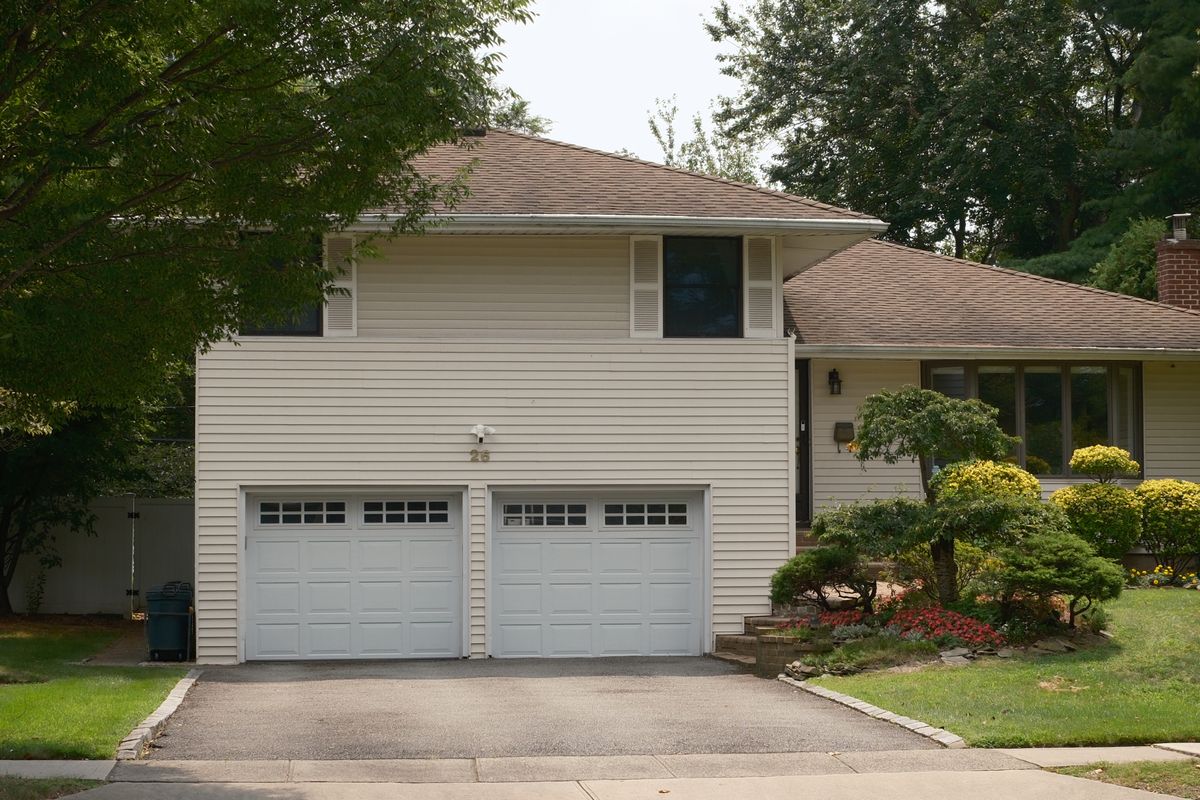
The first is the old inner-loop detached garage — the carriage house or the one-car bay behind a Heights bungalow, a Montrose cottage, or a Garden Oaks ranch. These doors and openers are frequently original to the house, which means a unit from the 1980s or 1990s, a door that predates current wind codes, and often a ceiling with very little headroom. The openers here are at the age where every part is a candidate: the gear, the board, the sensors, and the springs it pulls against. The second is the newer townhome and infill garage — Rice Military, Midtown, EaDo, and the rebuilt lots of Bellaire and Timbergrove. These are modern belt-drive units, frequently with smart control, but they live in tight two- and three-story shells where the garage is directly under living space, so the failure that matters is very often noise and the question is wall-mount versus belt rather than repair versus replace.
The two populations age in opposite directions: the old stock fails from cumulative wear, and the new stock fails from heat, surges, and being cycled hard because it is the only door the household uses. Knowing which one you have tells us most of the answer before we leave the truck.
Four parts inside the box, and only one of them is the motor
“The opener is broken” describes about four different machines. Inside the box on the ceiling there are four parts that do different jobs, and which one has gone wrong decides the repair, the price, and whether it is even worth repairing — so sorting them is where every opener call in the city starts.
- The drive train — the motor, the gearbox, and the chain, belt, or screw that pushes the door. Its signature failure is the nylon drive gear inside the gearbox losing its teeth: the motor keeps running and sounds perfectly healthy while the door refuses to budge. That gear is engineered to be the weak link that fails before the motor does, which is exactly why it is one of the cheapest and most worthwhile repairs on the list.
- The logic board — the circuit board that takes input from the wall button, the remotes, the sensors, and the travel limits and then decides what the motor should do. When a board fails it is usually erratic rather than dead: the opener behaves on Tuesday and ignores you on Wednesday, or it answers the wall button but not a remote, or it needs to be unplugged to reset before it will respond at all. It is also the part a nearby lightning strike can destroy in a single event.
- The safety system — the two photo-eye sensors near the floor, their wiring, and the auto-reverse behaviour they control. A sensor that is knocked out of alignment or has a dirty lens is one of the most routine callouts there is, and it shows up as a door that starts down, then stops and reverses — or that refuses to lower at all while the opener lamp flashes.
- The travel limits and force settings — the tuning that teaches the opener how far the door should travel and how much resistance counts as normal on the way. When that tuning is off, the door slams at the bottom, halts short, or reverses off nothing — and this is the subsystem that gets wrongly blamed for a fault that is really in the spring system.
What Houston heat, humidity, and salt air do to each of them
The national failure rates are written for a temperate average, and Houston is not that. Three local conditions attack the four systems above from different directions, and they are why an opener that would run twenty years in a Midwest garage may not here.
Heat. The opener is bolted to the ceiling of an unconditioned space, in the hottest layer of the hottest room, and on a July afternoon that ceiling air routinely runs well past 100 degrees for months at a stretch. Circuit boards, capacitors, and plastic gears all age on temperature rather than use, so a Houston opener can be electrically old while having been cycled surprisingly little. The tell is the unit that works on a cool morning and misbehaves every afternoon.
Humidity. Gulf moisture corrodes sensor terminals and the low-voltage bell wire stapled down the jamb, and that corrosion is what creates the classic on-again, off-again fault that tracks the weather rather than any particular part. It also swells and seizes roller bearings, so a door gets stiffer over time and the opener is asked to work harder against its own counterbalance.
Salt and the bayous. Toward the Ship Channel and the southeast side, salt-laden air pits the exposed metal and the sensor contacts from the outside in; inland, garages along Brays, Buffalo, and White Oak Bayou that have taken water rust from the damp slab up. Either way the floor-level components — the photo eyes and their wiring — fail first, which is exactly the pattern that reads as a phantom sensor fault.
The practical upshot is that a whole-home surge device at the panel and a surge protector on the opener outlet are unusually good purchases here, because the single most expensive electronic part in the room is also the most exposed.
The old inner-loop garage: original openers, low headroom, and a pre-code door
This is the housing stock that produces our most interesting opener calls. A detached garage behind a 1920s bungalow usually has a ceiling just high enough for the original door, which means the cheap, obvious fix — a conventional rail-and-motor unit — sometimes does not fit, and the right answer is a wall-mount jackshaft opener that bolts beside the torsion shaft and leaves the ceiling empty. That is not always the cheapest unit, and we will tell you plainly when a belt drive on a short rail is the honest call instead.
Two things follow from the age of this stock. The first is a safety question, not a convenience one: an opener old enough to predate the modern photo-eye standard has no external entrapment protection, and on that unit the conversation is not repair-versus-replace, it is replace on safety grounds regardless of whether the motor still runs. The second is a matching question on the door itself. Many of these doors are single-skin steel or the original wood, long out of production, so when the opener is the thing that failed but the door is the thing that is tired, the honest recommendation is often a new insulated door and opener together — see door and opener installation — rather than a new opener bolted to a door that will not outlast it.
Water: what the bayous did to the openers
Meyerland, Braeswood, and the neighborhoods along the bayous have taken repeat water, and a garage with a flood history changes an opener diagnosis the same way it does everywhere in the metro — but in the city it is the first thing we ask about, because homeowners who were not living in the house at the time simply do not know.
The motor and board usually come through, because they hang from the ceiling above the water line. The casualty is the gear mounted near the slab: the photo-eye sensors ride about six inches off the concrete so they go under first and are the last part to dry, and their wiring is stapled along the bottom of the wall where it traps moisture against the conductor for weeks. Water does not leave a clean break — it leaves a fault that shows up on a dry morning and vanishes by afternoon, which is why it gets mistaken for a board problem and why we check the sensors and their wire first on any garage with that history rather than last. If the unit or its low-voltage wiring actually sat under water, the correct repair is to replace the sensors and run fresh wire instead of re-testing corroded conductors, and a submerged unit should not simply be plugged back in to see what happens.
Storm season: why the openers on a whole block go dark the same week
Opener work in the city is seasonal, and the cause is electrical, not mechanical. A close lightning strike or a hard grid event does not have to touch the house to damage the opener: the transient rides in on the 120-volt branch, and it also couples onto the low-voltage wire running down the wall to the button and out to the sensors, which acts like an unshielded antenna stapled along a stud. Two things are worth knowing because they save a call. A unit that is completely dark is often not dead at all — first confirm the outlet itself is carrying power by plugging in a lamp or a phone charger, and check the breaker, because a storm frequently trips the garage circuit and a reset costs nothing. Only when the outlet is confirmed live and the head stays dark does that point at the board.
The harder call is the unit that comes back halfway — it still lifts the door but ignores the remote, or it runs yet refuses to close. That pattern usually means the receiver or the sensor circuit absorbed the hit while the motor and its power stage survived. In an outage, every opener has a red release cord that disconnects the trolley so you can lift the door by hand, and that only works smoothly if the springs are carrying their share of the weight — one more argument for keeping them in balance. A unit with battery backup will keep operating straight through a blackout, and in a city that loses power most summers, it is the option people are happiest to have paid for once they need it.
Reading the brand fault code before anyone drives out
Most openers will tell you what is wrong if you know how to ask. The fault codes are the same whether the garage is in the city or the suburbs, and we document them brand by brand so you can run the sequence yourself before calling anyone: LiftMaster and Chamberlain, Genie, and Craftsman. If the door runs fine from the wall button but not from the phone, that is a smart-control fault rather than an opener fault — see myQ not working. Remotes and keypads are their own category: when one stops talking to the unit the wall button still runs, the odds are it simply needs to be re-taught rather than replaced — remote not working and keypad not working walk through it, and a storm that wipes the memory is the usual trigger. The full troubleshooting order is on our opener troubleshooting guide, and the door that will not close guide handles the reverse case.
Repair or replace: where the line honestly falls in Houston
Our default is to fix what is fixable, and to tell you straight when fixing it is the wrong spend. Three things settle it: the unit’s age, which of the four systems failed, and whether the part for that exact model is still being made.
Worth repairing, almost always: a stripped drive gear while the motor and board are still healthy; a dead capacitor; the photo-eye sensors, their brackets, or a run of low-voltage wire; a travel or force setting that has drifted; a trolley or carriage that has worn. These are cheap parts and ordinary labour on a machine whose big-ticket components are fine.
Worth replacing, usually: a logic board on a unit already well past its mid-teens, especially when the board is no longer made and the surviving stock is scarce — at that point you are paying a big share of a new opener to put one new part into an old machine. The same goes for a seized motor, and for a unit so old it lacks the rolling-code receiver and the photo-eye standard altogether. If the opener has no photo eyes by the floor, that is not a repair question.
Whatever the answer is, the number you get is the number you pay — the firm quote for the diagnosed job is written before work starts, and it does not creep once the truck is there. To see honest ranges for both repair and replacement so you can check any quote against the market, use the Houston garage door opener repair cost guide.
What a Houston opener visit actually looks like
We do not arrive and start replacing parts until something works. The visit is a diagnosis first: run the manual-lift check, confirm power at the outlet, work through the sensors and the drive train in order, and only then give you a firm price for the specific fault we found. Because most opener work in the city is a gear, a capacitor, a sensor, or a remote, the truck is stocked with those common parts, so the majority of repairs are done the same day rather than booked for a return trip.
Whatever we end up doing, the door has to be left working as a system, not just the unit swapped. That means the travel and force limits are set to the door as it actually is, the auto-reverse is tested on both the photo eyes and the force sensor, the door’s balance is checked so the new or repaired opener is not asked to fight a failing spring system, and the remotes and keypad are re-programmed before we leave. Where the opener turned out to be the innocent bystander and the real problem is the door — a door off its track, worn cables, or a door overdue for a tune-up — we say so and fold it into the same visit. For the wider picture of what Houston garage work costs, the metro breakdown is here.