Short answer: before we can quote a commercial door here, two questions decide almost everything about how the job runs, and neither of them is about the door. Who controls the opening — you or your landlord — and how many times a day does it cycle? The first decides who authorizes and pays for the work, and what paperwork has to exist before a technician is allowed on site. The second decides whether you are buying a repair or buying a maintenance interval. Get those two answers ready and a commercial call here usually resolves in one visit.
The Woodlands is an office-and-retail commercial market, not a warehouse one
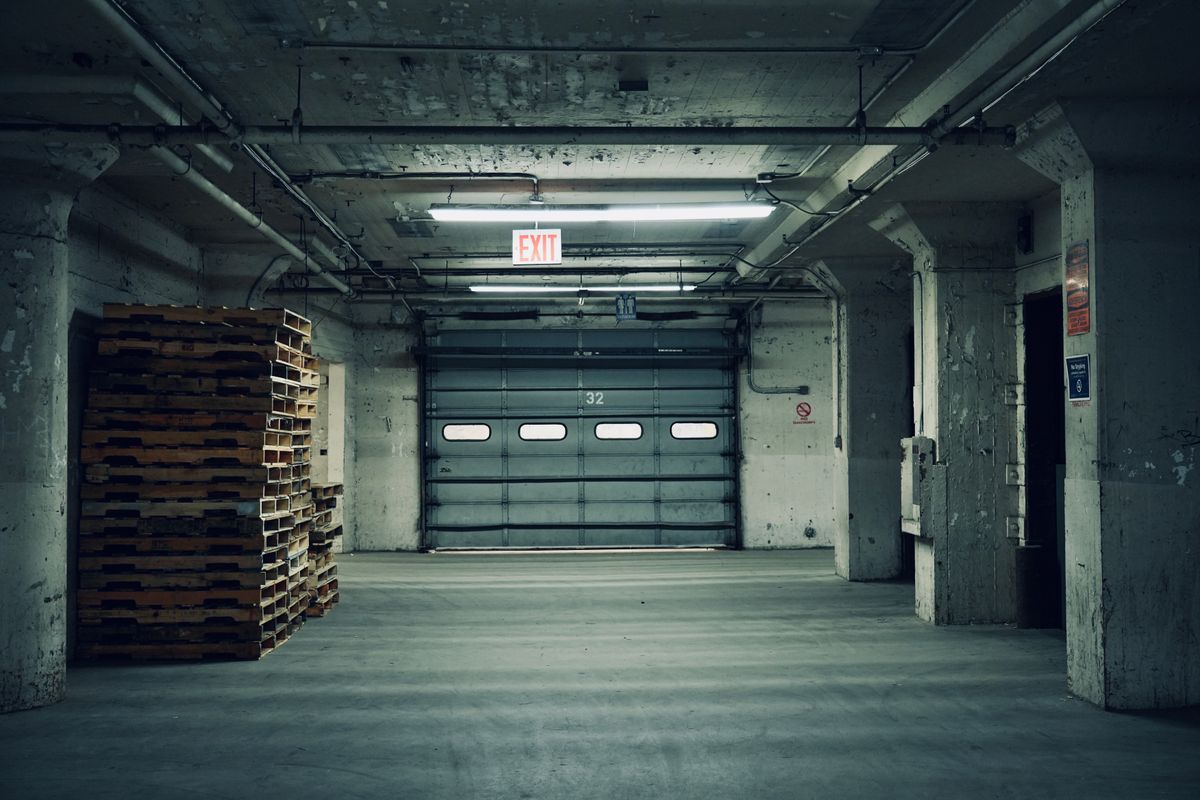
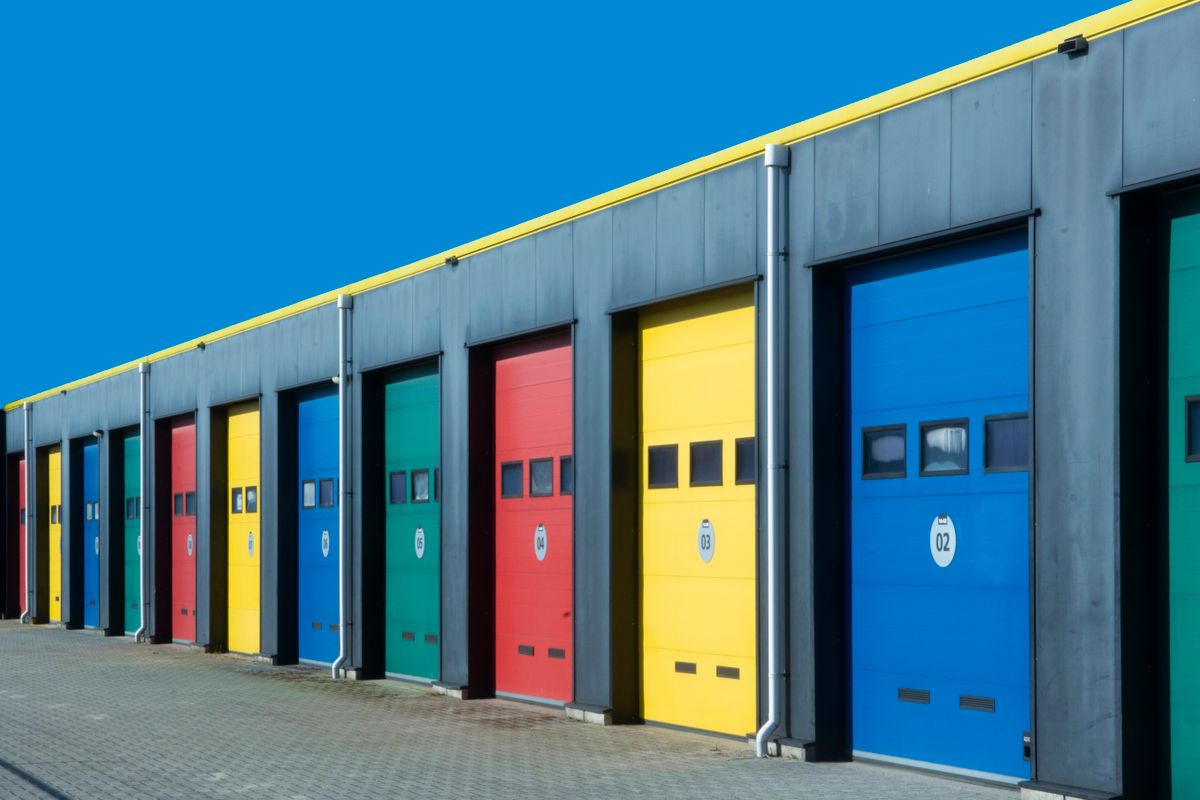
This matters because it changes which doors we actually see. Our Houston commercial door work is weighted toward heavy distribution equipment taking hundreds of cycles a day. The north corridor is a different building stock: business-park flex suites, medical and professional buildings with a service bay behind them, restaurant and retail tenancies, and light-industrial units serving the corporate campuses rather than a freight network. The doors that follow from that are sectional service doors at the back of a leased suite, rolling steel security grilles across a storefront or a service counter, fire-rated rolling doors in a shared wall or corridor separation, and a smaller amount of true dock equipment. A crew that only works distribution centers tends to over-spec every one of those.
The tenant-versus-landlord question, answered before we roll a truck
In a leased suite the overhead door is very often a landlord or common-area responsibility rather than a tenant one, and the answer lives in your lease rather than in any general rule. It is worth knowing which it is before the door fails, because the practical consequences are the ones that cost a day:
- Authorization. If the door is the landlord’s, a tenant approving the repair may be approving a charge they cannot recover. We would rather ask than assume, and we will speak to a property manager directly if you tell us who they are.
- Paperwork before access. Managed properties commonly want a purchase order number and a current certificate of insurance naming the building before a vendor is admitted. Sorting that out while a bay stands open is the slowest way to do it.
- After-hours and access windows. A retail or restaurant tenancy usually cannot give up a door during trading hours, and some parks restrict service vehicle access to set times. That is a scheduling constraint, not an emergency surcharge, and it should be agreed at booking.
Where a door is stuck open and the suite is standing unsecured, none of that waits — treat it as emergency service and settle the billing question afterwards.
Commercial doors are rated in cycles, so a business door ages in months
A residential door might run four to six cycles a day. A busy commercial bay can run forty or more, and a rolling grille on a food-service counter can run more than that. At that rate a door reaches a decade of residential wear inside a year, which is why calendar-based servicing is the wrong instrument here: the correct interval is set by counted cycles and duty, not by the anniversary of the install. It is also why the failure pattern differs. On a commercial door the parts that go first are the ones that move every cycle — bearings, hinges, the rollers and their stems, the counterbalance, and on rolling steel the curtain slats and guides — rather than the electronics that dominate residential calls.
The economics follow from that. A scheduled maintenance visit on a commercial door is not the same product as a residential tune-up; it is a downtime-avoidance purchase, and it is compared against the cost of a bay being unusable on a trading day rather than against the cost of the parts. On the doors that carry the business, quarterly or semi-annual service usually pays for itself the first time it prevents a closure. On a door that opens twice a week, annual is honest and we will say so.
Commercial operators are a different animal from a residential opener
The unit over a commercial door is an operator, not a consumer opener, and the differences are the sort that change what is safe and what is legal rather than merely what is convenient. Commercial installations are generally jackshaft or hoist units mounted to the wall or shaft rather than a rail-and-trolley unit hung from the ceiling, they are commonly wired to a fixed three-button open-close-stop station rather than driven only by remotes, and their entrapment protection is specified by the class of operation rather than assumed.
The part worth understanding as an owner is the control mode. A constant-pressure control only moves the door while somebody holds the button, so the person operating it is the safety system. A momentary contact control closes the door on a single press, which means the door must have its own external entrapment protection — a monitored photo-eye pair, a sensing edge on the bottom bar, or both — and that protection has to be working, not merely present. Two failure modes we find repeatedly in leased suites: a sensing edge that was damaged by a pallet and then bypassed to keep the bay running, and a three-button station replaced with a remote for convenience on a door that was never equipped for unattended closing. Both leave a business operating a powered door with its protection defeated, and both are cheap to put right compared with what they risk.
Fire-rated rolling doors carry an obligation the others do not
If your suite has a rolling steel door in a rated wall or corridor separation, it is fire equipment as well as a door. It is held open by a release mechanism and is designed to drop closed under a fire condition, which means the only way to know it will work is to release it and watch it close — a drop test — and then reset it. That testing is a documented, recurring obligation for the building, not an optional service, and a property manager will usually have a record of when it was last done. If nobody can produce that record, that is the answer. We test, reset and document these; where a door fails the test we report what failed rather than quietly resetting it.
What to have ready when you call
Commercial intake needs different information from a house call. Useful to us, in order: the door type (sectional, rolling steel, grille, dock), the approximate opening width and height, whether the door is fire-rated, the operator brand and the control station type, an estimate of daily cycles, and whether the suite can lose the opening during business hours. Photographs of the operator label and the control station are worth more than a description. Tell us the property manager and PO position at the same time and we can clear access before the truck is loaded rather than after. If what you have is a house rather than a suite, published ranges for that side of the work sit on this metro cost breakdown. Commercial doors are quoted per opening after we see the equipment, because the spread between a grille service and a dock overhaul is far too wide to publish honestly. For the wider north-corridor service area see our The Woodlands garage door repair page.