Short answer: stop pressing the button, and do not try to force the door back onto the rail with a pry bar or a rubber mallet. A door sitting crooked in its opening is still holding its full weight on cables and springs that are now loaded unevenly, and the two things people reach for first — the opener and a lever — are exactly what turn a one-hour bracket-and-roller job into a bent-track, creased-panel job. Pull the red release cord so the opener is out of the picture, leave the door where it is, and get eyes on it.
The general mechanics of an off-track door — the four distinct failures that all look identical from the driveway, how to tell them apart, and what the repair costs — are covered in depth on our Houston off-track repair page. This page is about something narrower and, if you live here, more useful: why Katy doors come off track for reasons that have very little to do with age, and why the pattern in these subdivisions looks so different from the one in the older inner-loop neighbourhoods.
Katy doors fail as a cohort, not one at a time
Almost everything west of the Grand Parkway went up inside a compressed window. Cinco Ranch, Seven Meadows, Grand Lakes, Firethorne, Cross Creek Ranch and the subdivisions around them were built out section by section, and within a section the doors are frequently the same builder-spec model, from the same supplier, installed by the same crew, within a year or two of each other.
That has a consequence homeowners notice anecdotally and then dismiss. When a door on your street comes off track, it is genuinely common for two or three more within a few blocks to follow over the next couple of seasons. It is not a coincidence and it is not contagious. It is a cohort of identical hardware, installed to identical tolerances, reaching the end of the same wear curve at the same time.
The parts that hit that wall first are the ones a builder package economises on, because they are invisible at closing. Light-gauge track that flexes rather than holding its radius. Rollers with plain steel wheels and unsealed bearings instead of sealed nylon. Thin hinges that elongate at the roller stem. None of these are defects — they are to spec, and the spec is a house that has just been built. Ten to fifteen years in, the stem hole on a number-three hinge has worn oval, the roller has developed enough play to climb the flange on a fast cycle, and the door comes off at the top corner on an otherwise ordinary Tuesday.
The practical value of knowing this: if a neighbour with your floor plan has just had rollers and hinges done, yours are the same age and the same part. A tune-up that replaces the wear parts before they let go is a materially cheaper transaction than the one that happens after the door has already come down crooked and dragged a panel edge across the track.
The wide double door is the one that goes
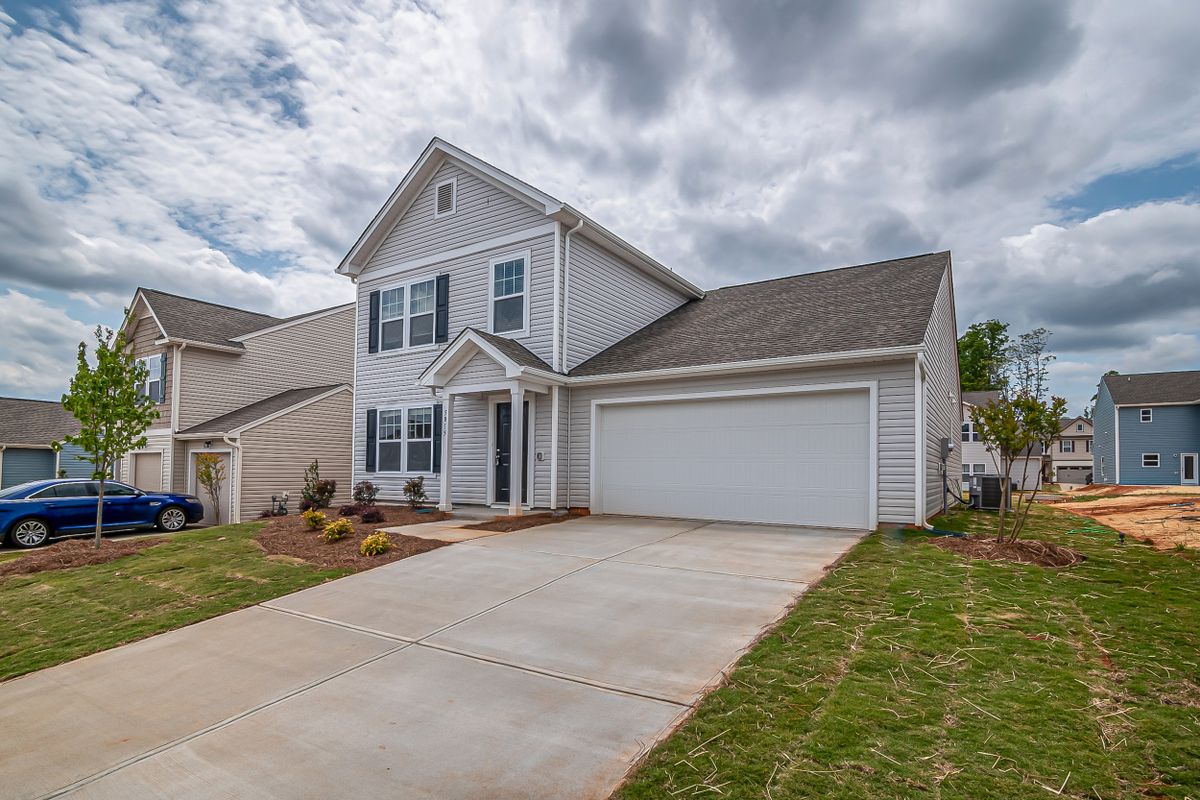
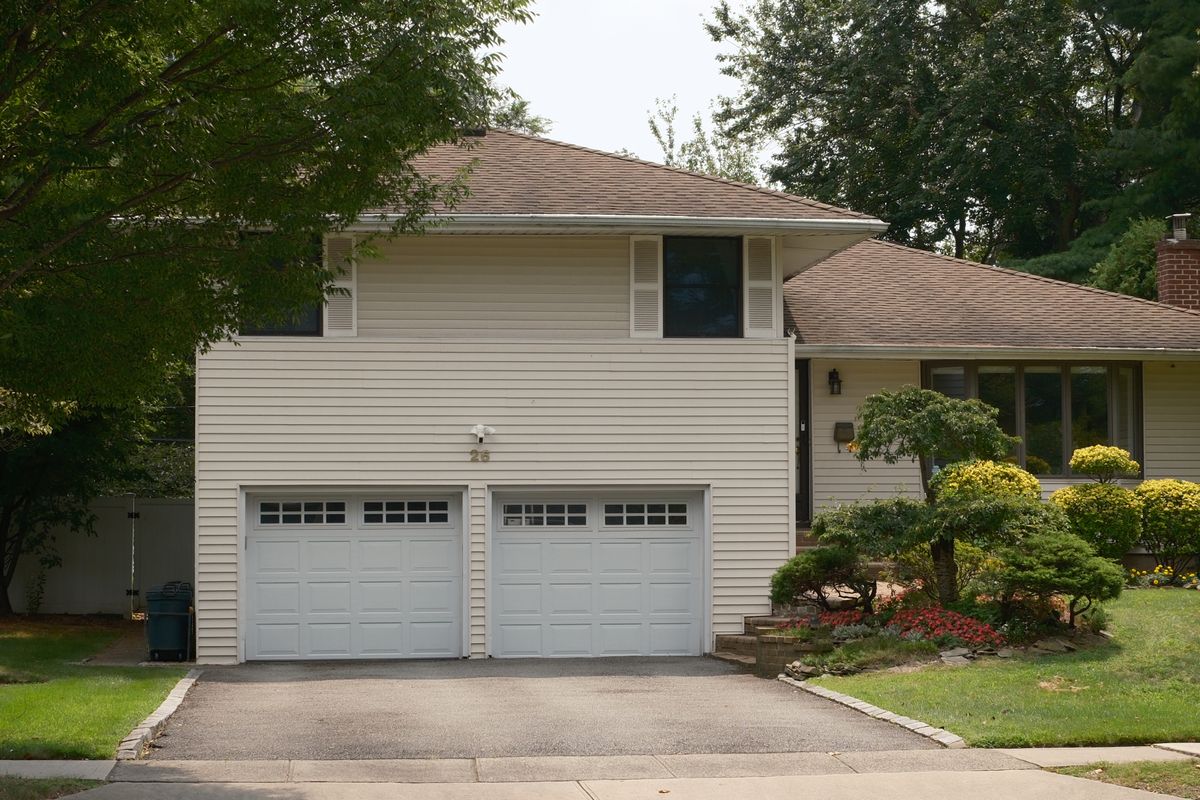
Katy’s newer builds lean heavily on the three-car configuration: a wide double door alongside a single. Those two doors on the same slab, in the same weather, on the same schedule, do not fail at the same rate, and the double is not a little worse — it is substantially worse.
A wide door is heavier, so every roller, hinge and cable carries more load. Its top section is long enough to flex measurably in the middle, which means the two top rollers are not always presented to the track at the same angle. It has more roller stations, so there are simply more places for one to bind. And critically, it has a much longer top fixture span, so a small amount of out-of-parallel between the left and right vertical tracks translates into a large mismatch by the time the door reaches the horizontal.
That last point is why a wide door tends to come off at one top corner while the rest of the door still looks fine. The failure presents as a single roller out of its rail near the top, the door hanging visibly lower on one side, and often a gap you can see daylight through along the top weather seal. On a single-car door the same tolerance error usually just makes the door noisy.
If your double is the one that keeps having trouble while the single beside it has never been touched, that asymmetry is diagnostic, not bad luck. It points at track alignment and roller condition rather than at anything you are doing wrong.
What the reservoir releases left in west Katy garages
Parts of west Katy sit inside and behind the Barker Reservoir flood pool, and in August 2017 the controlled releases and the reservoir pool put water into garages in a band of neighbourhoods that had never taken water before. Most of those doors were cleaned, dried, and went back into service, and for years they worked.
Water damage to a garage door does not present as a failure. It presents as a delay. The parts that sat submerged are the ones at the bottom of the assembly, and they are the ones under the most tension: the bottom brackets that anchor the lift cables, the lowest few feet of vertical track, the bottom roller stems, and the cable itself where it wraps the drum on its way down. Standing water — particularly water that carried mud and debris — pits galvanising, seizes bearings, and starts corrosion inside a bottom bracket where nobody can see it.
The failure arrives years later, and it usually arrives as one of two things. Either a corroded bottom bracket lets go under load, which drops that corner of the door and pulls it off the rail immediately, or a seized bottom roller stops rotating, drags rather than rolls, and gradually walks the door out of alignment until it jumps. Both read as “the door suddenly came off track.” Neither is sudden.
If your garage took water in 2017 and the door has never been properly inspected since, that history is worth mentioning when you call. It changes what gets looked at first, and it moves cable and drum condition from a routine check to the main event. A bottom bracket is a part under permanent spring load; it is one of the few components on a residential door where corrosion is a genuine safety matter rather than a longevity one.
Installation quality, not age, is the usual root cause here
Because the housing stock is comparatively new, Katy homeowners tend to treat off-track as an old-door problem and are surprised when it happens to a house they bought new. The surprise is misplaced. In this part of the metro, the most common underlying cause is not wear at all — it is an installation tolerance that was slightly out from the beginning and only became load-bearing once the wear parts loosened.
Three specific things recur. Vertical track that is not plumb, usually by a small enough margin that the door ran fine on new rollers with no play in them. Track brackets lagged into the jamb rather than into framing, which holds until the wood gives and the track shifts under the sideways load of a wide door. And horizontal track hung slightly low or without adequate support at the rear, so the door reaches the back of its travel and sags at the transition curve, which is where a great many top-corner jumps actually start.
The reason this matters to you as a buyer of the repair is that it changes what a correct repair looks like. If a crew puts the door back on the rail, replaces the rollers, and leaves, and the underlying cause was a track that was never plumb, the door will come off again. That is not a warranty problem with the parts; it is an incomplete repair. Realignment on a Katy door should include checking that the vertical tracks are plumb and properly anchored, not just that the door is back in them.
What to do in the first ten minutes
Order matters more than speed. First, stop operating the door, including from the wall button and the app. Nearly every expensive off-track job started as a cheap one and was made expensive by three or four more cycles. Second, pull the red release cord so the opener cannot be triggered by a remote in a car or by a family member who has not been told. Third, do not lift or lever the door. A door that is off at one corner is holding its weight on an asymmetric cable load; freeing it by hand is how people get hurt on this repair.
Then look at three things and note what you see, because it genuinely shortens the diagnosis. Is the door hanging lower on one side, or is it out at the top on both? Can you see a cable that has gone slack or come off its drum? Is there a visible kink or spread in the track itself, as opposed to a roller simply sitting outside an otherwise straight rail? A door that is out with straight track and taut cables is usually a roller and bracket job. A door with a slack cable or a deformed track is a different and larger conversation.
If the door is stuck partly open and the house is exposed, say so when you call — that changes the priority, and securing the opening is a separate step from repairing it properly. Our emergency service exists for exactly that gap.
The HOA problem nobody mentions until the panel is creased
This is specific to master-planned Katy and it catches people out. If the off-track event creased or folded a section — which is what tends to happen when a door is cycled after coming off — you are no longer only solving a mechanical problem. Most of these subdivisions run architectural guidelines that govern what the front elevation of the house may look like, and a garage door is usually the largest single element of that elevation.
The practical constraint is that a mismatched replacement section can be a compliance issue even when it is a perfectly good repair. Whether a single section can be matched comes down to whether your door’s exact model, gauge and embossing pattern are still manufactured — a question we cover properly on the Katy panel replacement page. If it is not still made, the honest answer may be a full door, and that is a decision worth taking to your association before the work rather than after.
The reason to raise it here is timing. The moment to find out whether your section is still available is while the door is being assessed, not three weeks later when a replacement panel arrives in a visibly different stamp.
When realigning is the wrong thing to buy
Not every off-track door should be put back on the rail. There are three situations where paying to realign is money spent on a door that is going to keep asking for more.
The first is a door that has come off more than twice in a couple of years with no obvious external cause. Repeat failures point at a structural or alignment issue in the opening itself, and each realignment is treating the symptom. The second is track that has been kinked, spread, or straightened before. Track is formed steel; once it has been deformed and bent back, it does not reliably hold its radius, and a door running on repaired track tends to find the same spot again. The third is a door with multiple creased sections plus corroded bottom hardware, which is common in the flood-affected pocket described above. At that point the repair cost starts converging on a new door that will be under warranty and correctly installed.
We will tell you which of these you are in. There is no version of this trade where quoting a realignment on a door that needs replacing serves us for longer than one visit.
Getting it looked at
Send us the make and rough age of the door if you know it, whether it is the wide double or a single, whether the garage has ever taken water, and what the door is doing now — hanging low on one side, stuck partway, cable off the drum, or visibly bent track. Those four details are usually enough for us to tell you before we arrive whether this looks like a roller-and-bracket afternoon or something larger, and to bring the right parts the first time. We will give you a firm price once the door has been diagnosed, and that is the price you pay.