Short answer: Katy opener calls sort into three buckets, and which bucket you are in changes the bill by an order of magnitude. Either something inside the unit has failed, or the unit is being asked to move a door it can no longer move, or nothing is broken at all and the remotes, the keypad, or the button in your car have simply lost their pairing. That third bucket is far larger here than people expect, and it is the cheapest visit we make. The symptom on its own rarely tells you which bucket you are in, which is why we diagnose before quoting.
The subsystem-by-subsystem diagnosis and the brand fault codes are set out on the city-wide opener repair page, and they apply everywhere in the metro. This page covers three things that are particular to Katy garages and that we end up explaining on almost every call out here.
Two and three-bay garages: the opener that still works hides the one that is failing
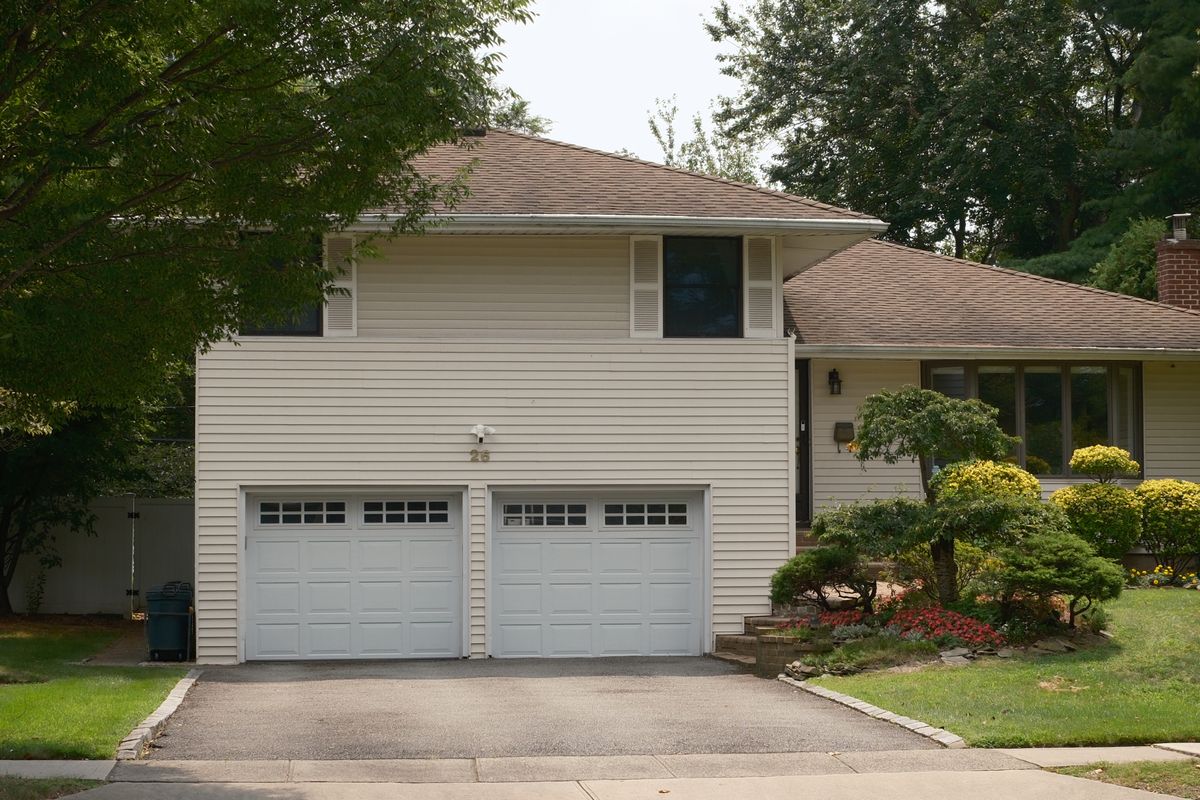
Most of what has been built in Katy over the last two decades has more than one bay, and a large share of it has three — frequently a double door plus a single, or a tandem bay running deep. That is a nicer garage than most of the country has, and it quietly changes how opener problems present.
The first effect is that a failing unit gets tolerated for months. When one bay stops responding reliably, the household simply routes through the other one, and what would have been an urgent call on a single-bay house becomes an annoyance that gets mentioned when something else breaks. By then the intermittent fault that would have been a sensor or a connection has usually had time to become a burnt contact or a dead board.
The second is that the two units are almost never in the same condition even when they are the same age. The bay in daily use has done several times the cycles of the one that holds the second vehicle or the workshop end of a tandem, so a household can be running one opener that is worn out and one that is barely used, bought and installed on the same day. Cycles, not calendar years, are what wear a drive train — so if you are trying to guess which unit is close to the end, count how often each door actually moves rather than how old the house is.
The practical consequence is a scheduling one, and it is worth saying plainly because it saves money. If one unit has failed and the other is the same vintage, ask us to look at both while we are there. The trip and the setup are paid once. That is not an upsell — if the second unit is fine we will tell you it is fine, and the answer is often that it needs nothing more than the travel and force settings re-checked and the hardware it pulls against serviced.
Remotes, keypads and the button in the car — the half of the job people forget
A meaningful share of the calls we take out here are not repairs at all. Nothing inside the opener has failed; the things that talk to it have stopped being recognised.
Modern openers use a rolling code: the remote and the receiver agree on a new code every press, which is what stops somebody capturing a signal in a parking lot and reusing it at your house. The trade-off is that the pairing is a stored relationship rather than a fixed number, and anything that clears the receiver’s memory — a board replacement, a full unit swap, sometimes a hard power event — clears every remote, keypad and vehicle button with it. If your door stopped answering a remote right after other work was done, that is expected behaviour and a two-minute fix, not a new fault. Re-pairing is documented step by step in our guide to a keypad that has stopped opening the door. The same sequence covers a handheld remote that has gone quiet.
Two Katy-specific notes on this. Vehicles with built-in garage buttons have to be taught the rolling code from the head unit, not from the remote, and a household that changes cars often ends up with a car that was never programmed and a spare remote nobody can find. And if you have bought a house here recently — a lot of people have — wipe the opener’s memory and re-pair only the remotes you hold. Sellers hand over the openers they remember. The one clipped to a contractor’s visor or lost in a moving box still opens your garage until the memory is cleared, and clearing it is free.
The keypad deserves a mention of its own, because it is the fix for a different problem: a door left open. If the recurring issue in your house is that somebody walks in and forgets the door, an outside keypad plus a working close routine is the cheap answer, and it beats replacing a perfectly healthy opener because it “keeps leaving the door up.”
Storm season, surges, and the openers that all fail in the same week
Opener work out here is seasonal in a way that surprises people, and the reason is electrical rather than mechanical. A logic board is the most surge-sensitive thing in a residential garage, and it does not take a direct strike to kill one. A nearby hit or a hard grid event puts a transient onto the 120V circuit — and, just as often, onto the low-voltage run that goes down the wall to the button and out to the safety sensors, which is effectively an unshielded antenna stapled along a stud.
The signature is worth knowing because it saves a service call. If the unit is completely dead — no LED on the head, no response from the wall button — check the outlet first with something else plugged into it, and check whether the garage circuit is on a GFCI that has tripped. A tripped GFCI is free to reset. If the outlet is live and the head is still dark, the board is the likely answer, and boards are frequently a repair rather than a replacement on a unit that is otherwise sound. The more ambiguous case is the one that half-works afterwards: responds to the wall button but not the remote, or runs but will not close. That pattern usually means the receiver or the sensor circuit took the hit rather than the whole board.
Two things are worth doing before the next storm rather than after it. A surge protector on the garage outlet is inexpensive and protects the single most expensive electronic part in the room; a whole-home surge device at the panel is better and protects the opener along with everything else. Neither is a guarantee — nothing is, against a close strike — but the ratio of cost to exposure here is unusually good.
The second is about outages, which in this part of the state can run long. Every opener has a red manual-release cord, and every household should know what it does before it needs it: pulling it disconnects the trolley from the door so you can lift by hand. Two cautions people learn the hard way. Do not pull it while the door is partway up unless you are prepared for the door’s full weight, and if the door is heavy by hand, that is a counterbalance problem and the door should be left down. To re-engage, most units re-latch automatically the next time the motor runs the trolley back over the carriage. Battery backup is not required by code in Texas the way it is in some states, but on a multi-day outage it is the difference between using your garage and parking on the street, and it is a sensible box to tick when a unit is being replaced anyway.
Garages that have taken water, and the sensors six inches off the floor
Katy sits in the Barker and Addicks watershed, and a meaningful number of garages out here have had water in them at some point. That history changes an opener diagnosis, and it is the one piece of context we most often have to ask about directly because homeowners do not think to mention it — particularly buyers who were not living in the house at the time.
The head unit itself usually survives, because it is bolted to the ceiling. What does not survive is everything at floor level, and that is where the fault almost always is. The photo-eye safety sensors sit about six inches off the slab by design, so they are the first components in the room to go under and the last to dry out. Their wiring runs along the bottom of the wall, as does the low-voltage run to the button, and both are typically stapled to the framing where they hold moisture against the conductor.
What water leaves behind is not a clean failure but an intermittent one, which is why these are the calls that get misdiagnosed and re-diagnosed. Corrosion inside a conductor raises resistance without breaking the circuit, so the sensor pair passes on a dry cool morning and drops out in the afternoon, and the door reverses for no reason anyone can reproduce. That reads exactly like a failing board, and people replace a perfectly good one chasing it. Sensor and wiring faults are the most common cause of a door that will not stay closed generally — the full list of causes is set out in our guide to a door that reverses or refuses to close — and in a garage with a flood history they are the first thing we look at rather than the last.
One safety point stated plainly: if a unit or its low-voltage wiring has been submerged, do not simply re-energize it and see what happens. On a garage with that history the honest repair is to replace the sensors and pull a fresh run rather than to test and re-test corroded wire, because the second approach costs more in labour than the parts are worth and does not stay fixed.
Wall-mount openers, high ceilings, and overhead storage
The other question that comes up on Katy opener calls far more than it does elsewhere in the metro is whether to move to a wall-mount unit. A wall-mount — also called a jackshaft — bolts beside the torsion shaft at the end of the door instead of hanging from a rail down the middle of the ceiling, and it drives the shaft directly. The ceiling ends up empty.
That matters here for reasons that are specific to the housing stock. Garages built in the last two decades out this way often have tall ceilings, and a rail-and-motor assembly hanging in that space is both awkward and, on a very high ceiling, an installation problem. More commonly the driver is storage: overhead racks are close to standard in Katy garages, and they compete for exactly the volume a conventional opener occupies. A wall-mount frees the whole span. It is also the quietest option by a clear margin, which is worth real money in the many houses here that have a game room or a fourth bedroom sitting right above the garage.
The honest limits, because this is a genuine upsell and should be presented as a choice rather than a recommendation. A wall-mount costs more than a belt or chain head unit, and the gap is not trivial. It requires a torsion-spring door — it cannot drive a door on extension springs — and it needs a shaft and bearing plate in sound condition, because the drive load now goes through them. It also assumes the door is properly balanced; a wall-mount is less tolerant of a door that is fighting itself than a rail unit is. If your existing chain drive works, is quiet enough, and the ceiling is not needed, replacing it with a wall-mount is a preference rather than a repair, and we will say so. Where it earns its price is a new door and opener bought together, a garage where the overhead space has a job to do, or a room above that someone is trying to sleep in. Those cases are worth pricing properly against a straightforward door and opener installation.
Two things worth checking before you call
First, find the label on the side or back of the head unit and note the model and the date. That single line tells us whether your board and gear are still stocked parts or superseded ones, which is most of the repair-versus-replace answer before anyone drives out. Ranges for both paths are published in the cost guide covering opener work across the metro, so you can sanity-check the number we give you.
Second, tell us whether the door has changed. An opener that has started stopping short, reversing, or straining is very often reporting a counterbalance problem rather than an internal one, and fitting a new unit to a door that is out of balance shortens the life of whatever you bolt up there — which is why we check the door before we quote a replacement, and why spring work sometimes turns out to be the actual repair. We work Katy and west Houston from our Katy garage door repair base, and we give you a firm number for the diagnosed job before any work starts.